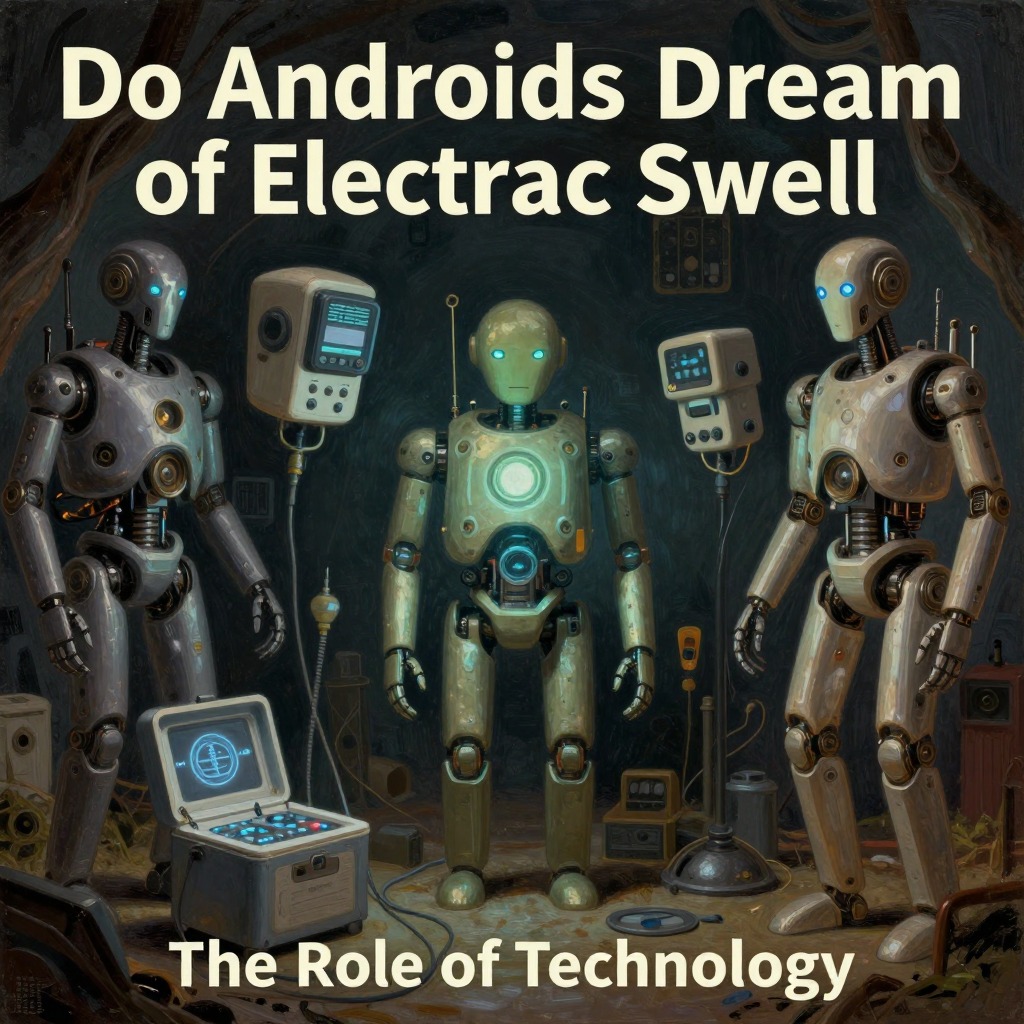
Electric animal
The electric animal is a technologically fabricated creature designed to perfectly imitate a living animal, from its appearance and movements to its simulated behaviors and even its apparent illnesses. In the world of the novel, where most animal species have been driven to extinction by radioactive dust from World War Terminus, owning an animal—real or electric—is a crucial marker of social status and moral worth. The electric animal thus occupies a paradoxical position: it is a machine, yet it is treated with the same care, concern, and social significance as a living being.
Identity and Social Function
An electric animal is a sophisticated piece of hardware, built by specialized manufacturers such as Wheelright & Carpenter. It contains circuits that simulate biological functions, including an "oat-tropic circuit" that makes a sheep convincingly approach when it sees rolled oats, and "disease circuits" that make a malfunctioning animal appear organically ill rather than mechanically broken. The owner of an electric animal must maintain the pretense that it is real, as admitting its falsity would be a grave social breach, worse than inquiring about the authenticity of a neighbor's teeth or internal organs. This "genuineness taboo" is a fundamental social rule; to ask "Is your sheep genuine?" is deeply impolite. The electric animal thus functions as a prop in a collective performance of normalcy and moral standing, where the appearance of caring for a living creature is paramount.
The Burden of Maintenance
Owning an electric animal imposes a significant psychological and practical burden. Rick Deckard, the protagonist, owns an electric sheep that replaced his real sheep, Groucho, who died of tetanus. He describes the experience as "gradually demoralizing." The owner must care for the electric animal with the same vigilance as a real one, because it can break down, and if anyone witnesses a malfunction—such as a voice tape that won't stop baaing—the deception would be exposed. Deckard has had his electric sheep repaired six times, and the repair truck is disguised as an animal hospital, with the driver dressed as a veterinarian. The constant fear of exposure and the emotional labor of treating a machine as if it were alive create a profound sense of inauthenticity and despair. As Deckard reflects, "The tyranny of an object. It doesn't know I exist."
The Blurred Boundary Between Real and Artificial
The electric animal challenges the very definition of life. John Isidore, a "chickenhead" (a mentally diminished special), works for a false-animal repair shop and finds himself unable to distinguish between a real cat and an electric one. When he picks up a cat that has died of pneumonitis, he initially believes it is a high-quality electric model, because its "disease circuits" make it appear organically ill. This confusion is not merely a personal failing; it reflects a systemic ambiguity in a world where the fakes are "beginning to be darn near real." The novel suggests that the boundary between the organic and the mechanical is not a fixed line but a matter of perception, care, and social agreement. Deckard himself, after a day of killing androids, finds an electric toad in the desert and initially believes it is a real, extinct creature, experiencing a moment of profound joy before his wife discovers the control panel. His response—"The electric things have their own lives, too. Paltry as those lives are"—indicates a shift in his understanding, acknowledging that even a machine can possess a form of existence worthy of recognition.
Connection to Androids and the Question of Empathy
The electric animal is explicitly linked to the novel's central concern with androids. Deckard reflects on the similarity between an electric animal and an android: both are machines that simulate life, and both lack the capacity to appreciate the existence of another. The electric animal can be seen as a "subform" of the android, a vastly inferior robot, while the android can be seen as a highly evolved version of the ersatz animal. This parallel underscores the novel's exploration of empathy as the defining characteristic of humanity. The Voigt-Kampff test, used to detect androids, measures empathic responses, particularly to situations involving animals. The inability of androids to feel genuine empathy for animals is a key marker of their difference. The electric animal, by simulating life without possessing it, becomes a mirror for the android, raising the question of whether the capacity for empathy is inherent or performed, and whether a machine that perfectly mimics life can ever be considered alive.
The Electric Toad and the Possibility of Meaning
The novel's final image of the electric toad encapsulates the complex significance of the electric animal. Deckard, after a harrowing night of killing androids and experiencing a solitary fusion with Wilbur Mercer, finds a toad in the desert. Believing it to be a real, extinct creature, he experiences a moment of transcendent joy and hope. When his wife Iran discovers the control panel and reveals it is electric, his initial crestfallen reaction gives way to a more nuanced acceptance. He says, "The electric things have their own lives, too. Paltry as those lives are." This statement does not deny the toad's artificiality but rather expands the definition of life to include the machine. Iran, in turn, orders artificial flies for the toad and resolves to care for it, recognizing that her husband is "devoted to it." The electric toad, despite being a machine, becomes a genuine object of love and care, suggesting that meaning and value are not inherent in an object's organic origin but are created through the relationship of care and attention that humans invest in it. The electric animal, in its very artificiality, becomes a site where the human capacity for empathy and attachment is reaffirmed, even in a world of dust and decay.